The Hidden Costs of Owning US Stocks in Europe
Published
Withholding tax, currency drift, and a $60,000 estate tax threshold almost no European investor has heard of. Three costs that never show on a trade confirmation.

The US takes 15% of your dividends, or 30% if a form is missing. It also claims up to 40% of your US shares above $60,000 when you die. Here is what owning American stocks from Europe actually costs.
What US shares actually cost a European investor
You buy Apple. You buy Microsoft. Maybe you buy a US dividend stock for the income. The trade costs a euro or two in commission and it feels like the whole story.
It is not.
There are three costs attached to holding US shares from Europe that never appear on a trade confirmation, and one of them can take 40% of your position when you die. I have paid two of them out of my own account and I can show you the numbers. The third I have not paid, and I would rather not surprise my family with it.
None of this makes US stocks a bad idea. I hold them. But they are not the same product for us as they are for an American investor, and almost nobody explains the difference.
Cost one: dividend withholding tax
If you own US shares directly, the US takes a slice of every dividend before it reaches you. The default rate is 30%.
That rate drops to 15% for residents of most European countries, because of tax treaties between those countries and the US. But it only drops if your broker has a valid W-8BEN form on file for you. That form certifies where you live and claims the treaty rate.
Here is what it looks like on a real statement. Two dividends on my HPE position over the past year:
Date | Gross dividend | US tax withheld | Rate |
|---|---|---|---|
16 Jan 2026 | $14.25 | $2.14 | 15.0% |
23 Apr 2026 | $28.50 | $4.28 | 15.0% |
Fifteen per cent, not thirty. That is the treaty rate applying because the form is in place.
The form expires
A W-8BEN stays valid for the year you sign it plus the next three calendar years. Sign one in 2026 and it lapses on 31 December 2029. Interactive Brokers emails you before it does, but if you miss it, withholding goes back to 30%, and it applies to more than dividends. IBKR states that a lapsed form can mean withholding on gross proceeds from sales, not just income.
Reclaiming is harder than preventing
Getting over-withheld US tax back means filing with the IRS. For most retail investors the effort exceeds the money. Getting the form right beforehand is the whole game.
Go and check your own statement now. If you see 30% coming off US dividends, the form is missing or expired.
Cost two: currency exposure
Your account is in euros. US stocks trade in dollars. Something has to convert, and it happens more often than you expect.
The conversions I did not ask for
Twice last year an assignment landed in my account before my dollars did. My USD balance went negative, once by about $2,227 and once by about $2,069, and IBKR converted euros automatically to cover it. On the December conversion the rate was 1.16406. In January it was 1.18517.
The interesting part: my statement shows no explicit commission on either conversion. That surprised me. IBKR's published rate for a manual conversion is 0.002% with a $2 minimum, which is already cheap, and the auto-conversions carried no separate charge at all. Whatever cost sat inside the exchange rate itself, I cannot isolate it from the statement, so I am not going to claim a number I cannot show you.
The exposure matters more than the conversion
Over the same period my account recorded a foreign exchange gain of €78.94 simply from holding dollars while the dollar moved. That is not skill. That is not investing. That is a currency bet I did not consciously place, and it happened to go my way. Inside that figure sit €92.20 of gains and €12.09 of losses, which tells you it moves in both directions.
If you hold US shares from Europe, part of your return is a currency position whether you want one or not. In a good year nobody notices. In a bad year it eats into gains you thought you had earned.
There is a common misunderstanding here worth clearing up. Buying a US-listed share in EUR on some other exchange does not remove this. Neither does buying a EUR-quoted ETF that holds US stocks. I covered why in the All-World ETF comparison: the trading currency is just the label on the price. The exposure comes from what the fund or the company actually holds.
Cost three: US estate tax
This is the section I wrote this article for.
How the threshold works
The US charges estate tax on US situs assets held by people who are not US citizens or residents. US situs assets include shares in US companies and US-domiciled ETFs. It does not matter where you live, where your broker is, or whether you have ever set foot in America. If you own the shares when you die, the US considers those assets within its reach.
A US citizen currently gets a lifetime exemption of $15 million from January 2026.
A non-resident, non-citizen gets $60,000.
Above that threshold, rates run from 18% up to 40%. The $60,000 figure is not indexed for inflation and has not moved in decades, so it quietly shrinks every year in real terms.
Sixty thousand dollars is not a large portfolio. A single sensible position in a few US megacaps clears it. Anyone who has been investing steadily for a decade with a US tilt is likely over it already and has probably never heard of the rule.
What your executor has to deal with
The US requires Form 706-NA from the estate of a non-resident holding US situs assets above the threshold, generally within nine months of death.
Brokers and transfer agents tend to enforce this in practice. Intermediaries often want evidence that US estate tax has been dealt with before assets move to heirs, which can mean your family cannot access the position until the paperwork is done.
A surviving spouse does not automatically solve it either. The unlimited marital deduction that US couples rely on does not apply in the same way when the surviving spouse is not a US citizen.
Your W-8BEN does nothing here
This is the single most common misunderstanding on the topic, so it is worth stating plainly. The W-8BEN reduces income tax on dividends. It has no effect on estate tax whatsoever. Two separate taxes, one form, and it only addresses one of them.
Treaties, and who gets one
The US has estate tax treaties with roughly fifteen countries. Where one exists, it may raise the exemption substantially or restrict what the US can tax. The UK treaty, for example, can give UK-domiciled individuals access to a pro-rata share of the full US exemption instead of the $60,000 floor.
But treaty relief is not automatic. It has to be claimed, usually with disclosure of the worldwide estate, and most European countries do not have such a treaty at all.
Find out whether yours does. It is a five-minute question with a very large answer attached.
The UCITS alternative
Here is the part that ties back to almost everything else on this site.
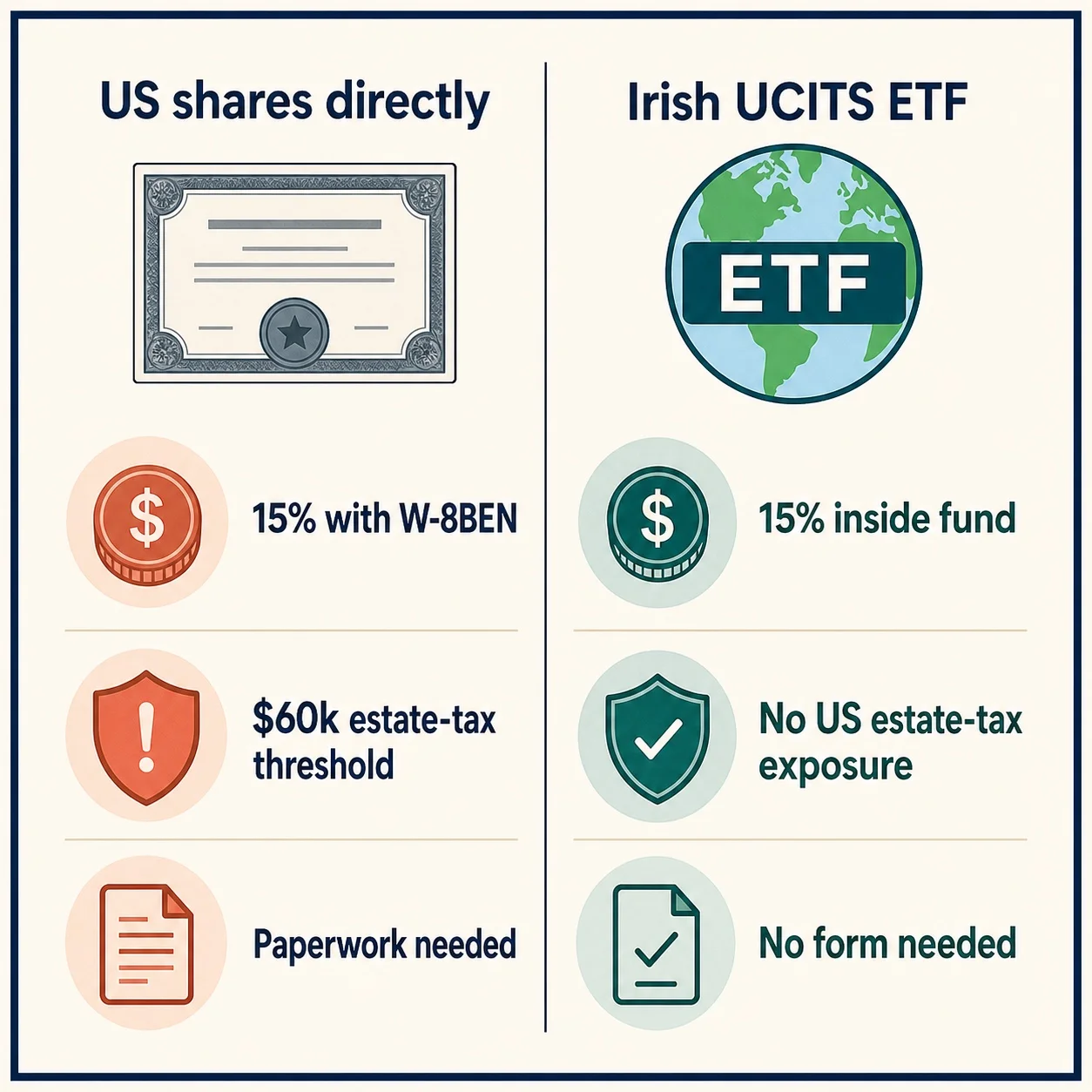
An Ireland-domiciled UCITS ETF is generally not a US situs asset. Shares in it sit outside the US estate tax net, regardless of how much US stock the fund holds inside it.
That is not a loophole. It is the reason the European ETF industry is built in Dublin. Ireland's tax treaty with the US also lets these funds pay 15% withholding on US dividends at fund level rather than 30%, and Ireland charges nothing further when the fund pays out to you.
So a European investor holding VWCE, IWDA or an S&P 500 UCITS ETF gets:
15% US withholding, handled inside the fund, no form required from you
No US estate tax exposure on the holding
The same underlying companies
Against a European investor holding Apple, Microsoft and Nvidia directly, who gets 15% withholding only if their paperwork is current, plus estate tax exposure above $60,000.
Check the ISIN. Irish-domiciled funds start with IE. Luxembourg funds start with LU and, despite Luxembourg having its own US treaty, they typically do not get the same 15% fund-level rate because of how they are legally structured. Domicile is not a detail.
If you want the practical version of this, the single-ETF approach sidesteps all of it by accident.
Why I still own US stocks
Because sometimes the structure that is tax-efficient is not the structure that does the job.
I hold HPE directly because I sell options against it, and you cannot do that with a European UCITS ETF. The options market on European-listed ETFs is thin to nonexistent. If you want to run an income strategy like the one I documented in my options results, you need liquid options, which in practice means US-listed shares.
That is a deliberate trade. I accept US situs exposure on that position because the strategy requires it. What I do not do is accumulate US-listed holdings by default, without noticing, across years, and end up with a large US situs estate I never chose.
The same logic applies to individual US dividend stocks. If you hold something like Realty Income or a basket of US dividend payers for the income, that is a real position with real appeal. Just count it towards the $60,000 and know it is counted. A dividend ETF domiciled in Ireland does a similar job without the estate exposure, though with less control over what you own.
Own US shares on purpose. Not by accumulation.
A short checklist
Open your broker statement and check the withholding rate on your last US dividend. If it is 30%, fix your W-8BEN.
Note the expiry year of your current form and put a calendar reminder in the final quarter before it lapses.
Add up the market value of everything you hold that is a US company share or a US-domiciled fund. Compare to $60,000.
Check whether your country has a US estate tax treaty.
For broad market exposure you intend to hold for decades, check the ISIN starts with IE.
If you are over the threshold and there is no treaty, this is the point to speak to someone qualified in cross-border estate planning. It is one conversation, and the alternative is leaving it to your family to discover.
Frequently asked questions
Do European investors pay US estate tax on US shares? Yes, potentially. US situs assets, which include shares in US companies and US-domiciled ETFs, fall within US estate tax for non-resident non-citizens above a $60,000 threshold, with rates up to 40%. An estate tax treaty between your country and the US may increase that exemption, but only around fifteen countries have one.
Does a W-8BEN protect me from US estate tax? No. The W-8BEN reduces withholding tax on dividend income, typically from 30% to 15%. It has no effect on estate tax at all. These are two separate taxes and the form only addresses one of them.
Do Irish-domiciled UCITS ETFs avoid US estate tax? Generally yes. Shares in an Ireland-domiciled UCITS ETF are treated as non-US situs assets, so they sit outside the US estate tax threshold even when the fund holds US stocks internally.
Why is US dividend withholding 15% for some European investors and 30% for others? The 15% rate comes from a tax treaty between your country of residence and the US, and it only applies when your broker holds a valid W-8BEN certifying your residence. Without a current form, the default 30% applies.
How long is a W-8BEN valid? It remains valid for the calendar year in which you signed it plus the following three calendar years. A form signed at any point in 2026 expires on 31 December 2029.
Nobody here is a licensed or certified financial adviser, and nothing in this article is investment advice. It is informational and educational only. Investments can fall as well as rise — do your own research, and speak to a qualified professional who knows your circumstances before acting on anything you read here.
Some of the links in this article are affiliate links. Using one costs you nothing extra, and we earn a small commission that helps keep this site running. If anything here saved you time or money, booking through our links is the easiest way to say thanks.