Accumulating vs Distributing ETFs: Which Should a European Investor Choose?
Published
Same index, same cost, two share classes. Your country of tax residence decides which one is actually cheaper, and the answer is not what most articles tell you.
There is no universally better share class. Accumulating UCITS ETFs reinvest dividends inside the fund. Distributing UCITS ETFs pay them out as cash. Equivalent share classes of the same index deliver broadly similar total returns before tax, so the decision turns on three things: your country of tax residence, whether you need the income now, and whether you are investing inside a tax wrapper. Accumulating is not automatically more tax efficient in Europe. Several countries tax undistributed fund income anyway.
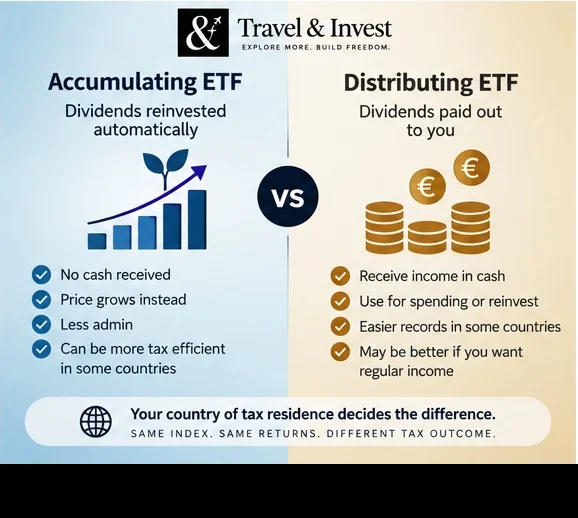
The short answer
What is an accumulating ETF? It collects the dividends its underlying companies pay and reinvests them inside the fund. Nothing reaches your account. The share price rises instead. Usually marked "Acc" or "C".
What is a distributing ETF? It collects the same dividends and pays them out to you in cash, usually quarterly. Usually marked "Dist", "Inc" or "D".
Is an accumulating ETF better? Not inherently. Three questions decide it, in this order.
Where are you tax resident? Germany, the United Kingdom and Ireland all tax accumulating funds in ways that remove most of the supposed advantage. The country table below sets out how.
Do you need the income now? A distributing fund gives you cash without selling anything. No accumulating fund can replicate that.
Are you inside a tax wrapper? Inside a UK ISA or SIPP, income and gains are sheltered and the tax question mostly stops mattering.
Key takeaway
Two share classes tracking the same index, with the same ongoing charge and the same domicile, should produce broadly similar total returns before tax. The only mechanical difference is what happens to the income, and what matters for a European investor is how their country of tax residence treats it. Accumulating is often simplest for someone still building wealth and not spending the dividends, because there is nothing to reinvest by hand and no dealing cost on small distributions. That is a convenience argument more than a tax one, and it is not universally true across Europe.
What separates an accumulating ETF from a distributing ETF?
One thing. What happens to the dividends.
Providers often run both classes over one index, which makes the comparison exact. The Vanguard FTSE All-World UCITS ETF exists in an accumulating class, ISIN IE00BK5BQT80, and a distributing class, ISIN IE00B3RBWM25. Same index, same 0.14% ongoing charge, same Irish domicile. The accumulating class buys more of the underlying holdings with the dividends and its share price rises. The distributing class pays them into your account and you decide what to do with them.
That is the whole mechanical difference. Everything else is downstream of it, and it is all tax and admin.
What stays the same whichever you choose
Total return before tax is effectively the same. The distributing fund's share price drops by roughly the distribution on the ex-dividend date. The accumulating fund's does not, because the money stayed inside. Over a year, holding the same index, the two land in broadly the same place.
Withholding tax inside the fund is the same. When a US company pays a dividend to an Ireland-domiciled UCITS ETF, the US withholds tax at fund level before the fund sees a cent, whether the fund then distributes or reinvests. Fund domicile changes that, distribution policy does not. See the hidden costs of owning US stocks as a European investor.
The management fee is usually the same. The Vanguard pair above charges 0.14% either way. Check the specific Key Information Document, because exceptions exist, but the fee is not normally where the two diverge.
So an accumulating ETF is not a tax shelter. It changes when your tax authority notices the income, and in several European countries the answer is that they notice it anyway. If the structure itself is new to you, start with what a UCITS ETF is and why the structure matters in Europe.
How different European countries treat accumulating and distributing ETFs
The internet's default answer, that accumulating is more tax efficient, comes from countries where undistributed income escapes tax until you sell. Several European countries closed that door years ago, which is why the table below matters more than any general rule.
Position as at 5 September 2026, sourced at the foot of the article. Rules and personal circumstances change the answer, so use this to start a conversation with a qualified adviser in your own country rather than to replace one.
Tax residence | Does Acc vs Dist matter? | Main reason |
|---|---|---|
Cyprus, non-domiciled | Potentially, modestly | No Special Defence Contribution on dividends for non-doms, but the GHS contribution of 2.65% generally applies to dividend income. No capital gains tax on securities. |
Cyprus, domiciled | Potentially, more so | Special Defence Contribution of 5% on dividends from 2026, plus GHS of 2.65%. No capital gains tax on securities. |
Ireland | Generally very little | 38% exit tax on both classes from 1 January 2026, plus deemed disposal every eight years. |
Germany | Generally very little | The Vorabpauschale charges accumulating funds an annual advance amount anyway. |
Netherlands | Generally no, under the standard Box 3 calculation | Box 3 taxes a deemed return on asset values rather than income received. |
United Kingdom, outside a wrapper | Mostly admin rather than amount | Excess reportable income is taxable in the year it arises. Reporting fund status matters more. |
United Kingdom, inside an ISA or SIPP | No | The wrapper shelters income and gains. |
The share class question sits on top of the fund choice, not instead of it. If you are still choosing the fund, work through the best all-world ETFs for European investors first.
Cyprus
Cyprus produces an unusual outcome because it charges no capital gains tax on the disposal of shares and securities, and because non-domiciled residents sit outside the Special Defence Contribution entirely. A charge on distributions is therefore not offset later by a charge on gains.
The non-dom exemption is not an interpretation. The Cyprus Tax Department states that the Special Defence Contribution is charged on dividends, interest and rents received by persons who are Cyprus tax residents and domiciled in the Republic. A tax resident who is not domiciled in Cyprus falls outside that charge.
One cost survives for a non-dom. The Health Insurance Organisation charges the General Healthcare System contribution at 2.65% on income from dividends, interest and rents, capped at 180,000 euros of total liable income per person per year.
Now note carefully where the published rule stops and my interpretation starts.
The published rule is the 2.65% GHS charge on dividend income subject to that cap, and the domicile condition on the Special Defence Contribution.
My interpretation is that a distribution from a foreign UCITS ETF would be treated as dividend income for a Cyprus tax resident, and would therefore be GHS liable. The published material does not address foreign UCITS ETF distributions specifically, and I have not found an official source that does. Confirm the treatment for your own circumstances before acting on it.
If that interpretation is right, then for a Cyprus non-dom below the cap, holding an accumulating class means there is no cash distribution for the charge to attach to. On 1,000 euros of annual distributions the charge would be 26.50 euros, and because Cyprus does not tax capital gains on securities, no equivalent charge would arise on disposal.
For a Cyprus tax resident who is domiciled in Cyprus, the Special Defence Contribution does apply to dividends. Following the 2026 tax reform the Tax Department's published rate table gives the rate as 5% from 2026 onwards, down from 17%, and the same reform removed rents from the charge after 31 December 2025.
For a domiciled resident the two charges stack: 5% plus 2.65% takes 7.65% of the gross dividend. On 1,000 euros of distributions that is 76.50 euros, against 196.50 under the pre-2026 rates. Subject to the same interpretation point, an accumulating class produces no cash distribution for those charges to attach to, and Cyprus does not tax the gain on disposal.
One transitional point. The reform draws its line at 2026 profits, so dividends paid out of earlier profits can fall under the old treatment for a period. The Tax Department's explanatory guide for individuals, updated in May 2026, sets out the detail.
Ireland
Ireland shows clearly why "accumulating defers tax" does not travel across borders.
Irish residents pay exit tax on ETF gains. From 1 January 2026 that rate is 38%, reduced from 41% in Budget 2026, covering Irish domiciled funds and equivalent offshore funds in EU, EEA and OECD treaty states. Deemed disposal survived: every eight years an investor is treated as having sold, is taxed on the paper gain, and receives a new base cost. Distributions are taxed at the same 38%.
Because both classes face the same rate, and because deemed disposal removes most of the deferral accumulating funds provide elsewhere, the distinction generally has a much smaller tax impact in Ireland than in countries where undistributed income is untaxed until sale. That is a statement about the shape of the regime, not a guarantee that two Irish investors see identical outcomes: timing of purchases, the eight year clock on each lot, losses and allowances all still vary. What remains is administration, where an accumulating fund is marginally lighter.
Change is coming. The Roadmap for the Taxation of Retail Investment sets out an Investment Account, to be legislated in Finance (No. 2) Bill 2026 and available from 2027, taxed annually on account value above a tax-free threshold, with deemed disposal not applying inside it. Removing deemed disposal from the existing regime is deferred to Budget 2028 and beyond.
Germany
Germany closed the deferral gap with the Vorabpauschale, an advance lump sum charge. It applies where a fund gained value during the year and its distributions did not reach a calculated base return, which in practice means accumulating funds are charged annually.
The calculation is fund value at the start of the year, multiplied by the Basiszins, multiplied by 0.7. The Bundesfinanzministerium set the Basiszins as at 2 January 2026 at 3.20% in a letter dated 13 January 2026. For an equity fund a 30% partial exemption applies, the Teilfreistellung, so 70% of the amount is taxable.
One timing detail catches people out. The Vorabpauschale for 2026 is treated as accruing on the first working day of the following year, which the same letter puts at 4 January 2027. German brokers withhold it automatically then. If cash disappears from a German brokerage account in early January, that is usually why.
The Sparerpauschbetrag, the annual tax-free allowance for investment income, is 1,000 euros for a single person and 2,000 for a jointly assessed couple. Filing a Freistellungsauftrag means that allowance absorbs the Vorabpauschale on a modest portfolio entirely.
For a German investor the share class is therefore close to neutral on tax, and the choice comes down to preference.
Netherlands
The standard Netherlands Box 3 calculation for 2026 is based on the value of your assets, not the dividends you received. The Belastingdienst applies a 6.00% deemed return to investments and other assets, taxed at 36%, with a tax-free allowance of 59,357 euros per person. The investments percentage is final for 2026; those for bank deposits and debts remain provisional until early 2027.
Because that calculation runs off asset values, the accumulating versus distributing choice generally does not directly determine a Dutch investor's standard Box 3 liability. On the standard route, the choice is about convenience.
The important caveat sits here, at the conclusion, because it is easy to miss. Following the litigation over Box 3, a counter-evidence route allows a taxpayer to be assessed on actual return where that is lower than the deemed return. Actual return is built from what you really earned, so on that route the income a fund distributes is no longer irrelevant. If you expect to use the counter-evidence route, take Dutch advice on how ETF distributions are treated within it before choosing a share class on the assumption that it does not matter.
United Kingdom
Inside an ISA or a SIPP the question largely disappears. Income and gains are sheltered, so hold whichever class you find easier to manage.
Outside a wrapper the position surprises most people. An accumulating offshore ETF does not defer UK income tax. Income the fund earns but does not distribute is treated as excess reportable income and is taxable in the year it arises, whether or not you received cash.
Two consequences follow. First, you have to track it and report it on the foreign pages of a self assessment return, as dividends for an equity fund. Second, you have to add cumulative excess reportable income to your acquisition cost when you sell, or be taxed twice on the same money.
Before any of that comes reporting fund status. An offshore fund without it has its gains taxed as income rather than as capital gains, which is materially worse. Most large UCITS trackers hold it and HMRC publishes the approved list, so check rather than assume.
For a UK investor outside a wrapper, a distributing fund is often the easier administrative choice, because the cash you are taxed on actually arrives. Inside an ISA, accumulating is the lower effort option.
Which ETF share class should you choose?
Four questions, in order. A decision aid rather than advice, and the last step is deliberately about preference.
1. Do you need the income now? If yes, a distributing class may make more sense: cash arrives without you selling anything. If no, continue.
2. Does your country tax undistributed ETF income? If yes, as Germany and the UK outside a wrapper both do, the tax advantage of accumulating largely disappears and you are choosing on convenience. If no, accumulating is often the simpler choice.
3. Are you investing through a tax wrapper? If yes, the tax distinction becomes largely irrelevant. If no, check your own country's rules. Ireland taxes both classes at the same rate. The Netherlands ignores income under the standard calculation. Cyprus charges the income but not the gain.
4. Do you actually want cash distributions? The honest tiebreaker once tax stops deciding. Some people stay invested through bad years because income keeps arriving; others find idle cash a nuisance. Staying invested matters more than optimising a share class.
When each share class makes more sense
A distributing ETF makes more sense if you want income without selling, which is the basis of how dividend investing works in practice and why the dividend focused UCITS ETFs available in Europe are all distributing. It also lets you rebalance by pointing distributions at whichever holding is below target, avoiding realised gains in countries that tax them, and it simplifies UK record-keeping outside a wrapper.
An accumulating ETF makes more sense if you are still building wealth and want zero friction: dividends go back in automatically, in full, at no dealing cost. That matters most when a quarterly payment is smaller than your broker's minimum commission, and when a currency conversion would otherwise sit between the fund and your account. Subject to the interpretation point above, a Cyprus resident holding outside a pension may also find the choice directional rather than a wash.
The reinvestment friction nobody prices in
Forget the percentage your broker charges. The number that costs you is the minimum commission per order.
Take a 10,000 euro holding in the Vanguard FTSE All-World UCITS ETF distributing class, ISIN IE00B3RBWM25, which trades on Xetra in euro as VGWL. Over the twelve months to 4 September 2026 it paid 2.01 euros per share, a trailing yield of 1.50% on justETF's figures. On 10,000 euros that is about 150 euros a year, quarterly, so roughly 37.50 euros each time.
Here is what reinvesting each 37.50 euros costs, on fee schedules published 5 September 2026.
Cost component | Trading 212 Invest | Interactive Brokers, no conversion | Interactive Brokers, with conversion |
|---|---|---|---|
Commission at the stated rate | None charged | 0.05% of 37.50 euros, which is 1.9 cents | 0.05% of 37.50 euros, which is 1.9 cents |
Minimum commission per order | None | 1.25 euros, applied instead | 1.25 euros, applied instead |
Currency conversion cost | None. Dividends credited in the primary account currency, exempt from the FX fee | None. Euro balance buys a euro-quoted line | 0.20 basis points, subject to a 2.00 dollar minimum, so 2.00 dollars applies |
Cost per reinvestment | 0 euros | 1.25 euros | 1.25 euros plus 2.00 dollars |
Cost over four reinvestments a year | 0 euros | 5.00 euros | 5.00 euros plus 8.00 dollars |
Share of the 150 euros of income | 0% | 3.3% | 3.3% plus the dollar cost, taking the total to roughly 8% at recent exchange rates |
Read the second row again. The stated commission rate produces 1.9 cents. The minimum charge is 1.25 euros, more than sixty times larger. At this size the percentage is irrelevant. The floor is the fee.
That leads somewhere rarely stated plainly. The same 1.25 euro minimum is 3.3% of a 37.50 euro distribution, 0.33% of a 375 euro distribution from a 100,000 euro holding, and 0.03% of a 3,750 euro one. So the reinvestment argument for accumulating funds is strongest for small portfolios and weakest for large ones, which is the reverse of how it is usually presented. It is also why ETF fees affect long-term returns more than most investors expect.
Trading currency, share class currency and distribution currency are different
Five currencies can appear in one ETF holding, and conflating them causes most of the confusion.
Layer | What it is | Carries investment risk? |
|---|---|---|
Underlying asset currencies | The currencies the fund's holdings are priced in, often dozens | Yes. This is the only one that does |
Share class denomination | The currency the fund reports that class's net asset value in, often US dollars | No |
Trading or quotation currency | The currency of the exchange line you buy, for example euro on Xetra | No |
Distribution currency | Normally the share class denomination currency, though some funds and listings offer others, so check the fund's documentation | No |
Currency your broker credits you in | A broker decision, not a fund decision | No, but this is where cost usually appears |
The plumbing still costs money, and the two brokers I use handle it differently. Trading 212 credits dividends in your primary account currency and exempts those payments from its 0.15% FX fee, so a euro account holding a dollar-denominated class receives euro with no conversion charge. Interactive Brokers credits the distribution in the currency paid, and converting it is a separate spot transaction with a 2.00 dollar minimum per order, which on a small distribution is effectively the whole cost.
Open your own broker's fee page and check which situation you are in. It changes the arithmetic above completely. It is not a reason to choose a broker.

Why I use both accumulating and distributing ETFs
I hold both classes on purpose. They do different jobs. Neither is there because I think it is inherently superior.
The accumulating classes do the wealth-building job. At Interactive Brokers I hold the Vanguard FTSE All-World UCITS ETF, accumulating class, ISIN IE00BK5BQT80. At Trading 212 I hold the State Street SPDR MSCI All Country World UCITS ETF, unhedged accumulating class, ISIN IE00B44Z5B48. Two brokers rather than one is deliberate, for platform diversification. The funds track FTSE All-World and MSCI ACWI respectively, but the exposure is close enough that I treat them as the same job done twice.
I buy both on Xetra, in euro, under the tickers VWCE and SPYY. Using the currency layers above: the share class denomination is US dollars, the trading currency is euro, and the holdings sit in dozens of currencies. Buying the euro line from a euro balance means no conversion when I place the order.
Both are accumulating because that money is not for spending. It compounds without me touching it, and without dealing costs on distributions I would only be putting straight back in.
The distributing class does the income and learning job. I hold the Fidelity Global Quality Income UCITS ETF, ISIN IE00BYXVGZ48, the distributing income class, on Xetra as FGEQ, at Trading 212. Distributions reach me in euro and cost nothing, because Trading 212 credits dividends in the primary account currency and exempts them from the FX fee. It is a smaller position, deliberately distributing, for lower volatility exposure and to start building an income stream. An accumulating fund cannot teach you anything about how receiving income feels.
The volatility part holds up, modestly. On justETF's figures for the year to 4 September 2026, the Fidelity fund's annualised volatility was 9.41% against 10.23% for the Vanguard FTSE All-World distributing class, with a trailing yield of 2.02% against 1.50% at an ongoing charge of 0.40% against 0.14%.
Two honest observations. Quality income does not mean defensive: on the fund's published holdings as at 31 July 2026, its largest positions were NVIDIA, Apple, Alphabet and Microsoft, with 34.6% in technology and 68.3% in the United States. Anyone expecting utilities and consumer staples should open the holdings list first. And the yield advantage over a plain all-world fund is thin: about half a percentage point, against 0.26 points of extra ongoing charge.
Below both sits a small satellite for stock-picking experience. Individual dividend stocks including Realty Income, VICI Properties, Coca-Cola, PepsiCo, Procter & Gamble, McDonald's, Waste Management, AbbVie, Visa and Main Street Capital, kept under 8% of the portfolio. They exist for the experience, not because I think I can beat the index. For how I split a core from satellites, see the 70/10/10/10 approach to splitting a portfolio and Grow Your Wealth in Europe.
Living in Cyprus puts me inside the exact trade-off this article describes. The accumulating core produces no distributions, so no Cyprus charge on income arises. The Fidelity position and the individual stocks do, and which charges apply depends on domicile. That is a cost I accept for the experience, with the position kept small.
My US stocks carry one more layer. I have a valid W-8BEN on file, so US dividend withholding runs at 15% rather than the 30% default. That is the same rate an Ireland-domiciled UCITS fund suffers on its US holdings inside the fund. The difference is where you see it: on your statement every quarter with direct shares, and nowhere at all inside a fund, which is why so many European investors underestimate it.
Starting again with one account and no interest in learning how income investing feels, I would hold the accumulating core and stop there.
What I got wrong about ETFs
Two things. Neither is the share class question.
I started in US-domiciled ETFs. My first holdings were VOO, the Vanguard S&P 500 ETF, and SCHD, the Schwab US Dividend Equity ETF, bought through a different broker before I understood what fund domicile does to a European investor. Both are good funds. Neither is built for someone living in Cyprus. US-domiciled funds put a European holder inside the reach of US estate tax on holdings above 60,000 dollars, and they lack the treaty position an Ireland-domiciled UCITS fund has at fund level. I hold UCITS funds only now.
Most European investors hit a practical wall before they reach the tax argument. Since PRIIPs and MiFID II took effect at the start of 2018, a fund sold to European retail investors needs a Key Information Document. Most US-domiciled ETFs do not produce one, and brokers withdrew them. If you already hold one you can usually keep or sell it, but you cannot buy more. Plenty of people meet the domicile question that way, through a rejected order. I would rather you met it here.
I started with the S&P 500 and have not finished switching. My first UCITS holding was the iShares Core S&P 500 UCITS ETF, accumulating class, ISIN IE00B5BMR087, ticker SXR8 on Xetra. I later decided a global fund suited me better and moved my regular buying to all-world. I have not sold the SXR8 shares. I intend to. I have not made the decision yet.
Worth being straight about that. In most European countries a legacy holding stays put because selling would crystallise a taxable gain, and that is a good reason. Cyprus charges no capital gains tax on securities, so that reason is not available to me. What is left is a decision I keep not making, which is a different thing from a decision I have made.
The overlap is real either way. A global index already contains the S&P 500 companies, so holding both tilts a portfolio towards large US companies whether or not that was intended. That trade-off is set out in S&P 500 versus all-world ETFs compared.
Checklist before choosing
Confirm your country of tax residence and how it taxes fund income and gains, and whether it taxes undistributed income anyway. Germany and the UK outside a wrapper both do.
Check whether a tax wrapper is available to you.
UK investors: confirm the fund holds UK reporting fund status.
Find your broker's minimum commission per order, not the headline percentage, and check how it credits distributions in the share class currency.
Take local advice before acting.
Frequently asked questions
Is an accumulating ETF better than a distributing ETF? Neither is better in general. Accumulating suits investors still building wealth who do not need the income and live somewhere that does not tax undistributed fund income. Distributing suits those who want cash without selling. Both classes of the same index should return broadly the same before tax.
What is the difference between Acc and Dist ETFs? An Acc, or accumulating, ETF reinvests dividends back into the fund, so the share price rises and no cash reaches you. A Dist, or distributing, ETF pays them out in cash, usually quarterly. The index, ongoing charge and fund domicile are normally identical.
Should I buy an accumulating or distributing ETF for long-term investing? For a long horizon with no need for income, an accumulating class is usually simpler, because reinvestment is automatic and free. That advantage weakens in Germany and in the UK outside a wrapper, where undistributed income is taxed as it arises.
Is an accumulating ETF more tax efficient than a distributing one? Not automatically, and in several European countries not at all. Germany charges an annual Vorabpauschale, the UK taxes excess reportable income as it arises, and Ireland applies the same exit tax rate to both classes. The efficiency argument only holds where undistributed income escapes tax until sale.
Are accumulating ETFs available as UCITS ETFs? Yes. Most large UCITS ranges offer both classes over the same index. The Vanguard FTSE All-World UCITS ETF exists as an accumulating class, IE00BK5BQT80, and a distributing class, IE00B3RBWM25, both Ireland-domiciled and charging 0.14%.
Do accumulating ETFs avoid dividend withholding tax? No. Withholding is deducted inside the fund before the money reaches the share class, so it applies identically either way. Fund domicile changes withholding, not distribution policy.
Can I switch from a distributing to an accumulating ETF without tax? Usually no. Selling one class and buying another is a disposal in most jurisdictions even when the index is identical, and can crystallise a taxable gain. Cyprus, which does not tax capital gains on securities, is an exception here.
Which is better for a beginner investing small amounts monthly? An accumulating class is usually less work at small balances, because a distribution of a few euros can be smaller than a broker's minimum commission per order. The exception is a UK investor outside an ISA.
In what currency will my distributions arrive? Normally in the share class denomination currency, often US dollars even when the fund was bought in euro on a German exchange. What reaches your account depends on your broker. Trading 212 credits dividends in the primary account currency without charging its FX fee; Interactive Brokers credits the currency paid, and converting is a separate transaction with a minimum charge.
How do I tell which share class a fund is? The fund name and the Key Information Document state it. Accumulating classes usually carry "Acc" or "C", distributing classes "Dist", "Inc" or "D". German listings say "thesaurierend" and "ausschuettend". Confirm the ISIN, because tickers vary by exchange.
Does an accumulating ETF still show a yield? Usually not, and that surprises people. The underlying holdings still pay dividends, so the income exists, but it is reinvested inside the fund on the ex-date and shows up in the share price rather than as a published yield. On justETF, for example, the distributing class of the Vanguard FTSE All-World UCITS ETF has a full dividends section with a current yield, while the accumulating class of the same fund shows no dividends section and no yield at all. To gauge the income, look at the distributing sibling of the same fund, which tracks the same index, or at the index’s own dividend yield.
Related reading
How this article was verified
Every tax figure and fee was checked against the tax authority's or the provider's own published source on 5 September 2026, rather than a secondary summary.
One distinction runs through the article. What a rule says is a published fact and is treated as one. How a rule applies to a specific holding is not always addressed by the authority, and where it is not, the text presents my reading as a reading. The clearest example is the treatment of foreign UCITS ETF distributions for the Cyprus General Healthcare System contribution.
This article has not been reviewed by a tax professional and is not advice.
Sources
All figures stated as at the dates below.
Cyprus, Special Defence Contribution charged on dividends, interest and rents received by persons who are Cyprus tax residents and domiciled in the Republic, and the rate table from 2026 onwards showing 5% on dividends: Cyprus Tax Department. Read 5 September 2026. https://www.gov.cy/mof-tax/documents/ektakti-amyntiki-eisfora-eae/
Cyprus, Special Defence Contribution and GHS both withheld on dividends for tax year 2026: Cyprus Tax Department announcement, 26 March 2026. https://www.gov.cy/oikonomia/katavoli-ektaktis-eisforas-gia-tin-amyna-kai-gesy-gia-tokous-merismata-kai-logizomena-merismata-gia-to-forologiko-etos-2026/
Cyprus, GHS contribution rate of 2.65% on income from dividends, interest and rents, and the 180,000 euro maximum annual income on which contributions are calculated: Health Insurance Organisation. Read 5 September 2026. https://www.gesy.org.cy/en-us/hiofinancing
Cyprus, explanatory guide and FAQs on the 2026 tax reform for individuals, editions dated 11 May 2026: Cyprus Tax Department. https://www.gov.cy/mof-tax/documents/forologiki-metarrythmisi-2026/
Ireland, exit tax on investment undertakings and life assurance reduced from 41% to 38% for income and gains arising on or after 1 January 2026: Revenue, Budget 2026 Summary. https://www.revenue.ie/en/corporate/press-office/budget-information/current-year/budget-summary.pdf
Ireland, the same measure: Department of Finance, Budget 2026 Tax Policy Changes Summary. https://assets.gov.ie/static/documents/993be018/Budget_2026_Tax_Policy_Changes_Summary.pdf
Ireland, the Investment Account to be legislated in Finance (No. 2) Bill 2026 and available from 2027, and the deferral of any change to deemed disposal to Budget 2028 and beyond: Department of Finance, Roadmap for the Taxation of Retail Investment. https://assets.gov.ie/static/documents/a5d640c2/Roadmap_for_the_Taxation_of_Retail_Investment.pdf
Ireland, mechanics of the eight-year deemed disposal and taxation of ETF distributions: Revenue Tax and Duty Manual Part 27-01A-03, October 2020. Cited for mechanics only; it predates the rate change and still states 41%. https://www.revenue.ie/en/tax-professionals/tdm/income-tax-capital-gains-tax-corporation-tax/part-27/27-01a-03-20201001155445.pdf
Germany, Basiszins of 3.20% as at 2 January 2026 for calculating the Vorabpauschale under section 18(4) InvStG, and the 2026 Vorabpauschale treated as accruing on 4 January 2027: Bundesfinanzministerium letter dated 13 January 2026. https://www.bundesfinanzministerium.de/Content/DE/Downloads/BMF_Schreiben/Steuerarten/Investmentsteuer/2026-01-13-basiszins-berechnung-vorabpauschale.html
Netherlands, Box 3 for 2026: 6.00% deemed return on investments and other assets, 36% rate, 59,357 euro allowance per person, with bank deposit and debt percentages provisional until early 2027: Belastingdienst. https://www.belastingdienst.nl/wps/wcm/connect/nl/box-3/content/berekening-box-3-inkomen-2026
UK, offshore funds and excess reportable income: HMRC helpsheet HS265. https://www.gov.uk/government/publications/offshore-funds-self-assessment-helpsheet-hs265/hs265-offshore-funds
UK, treatment of UK investors in offshore funds: HMRC Investment Funds Manual IFM12146. https://www.gov.uk/hmrc-internal-manuals/investment-funds/ifm12146
UK, approved offshore reporting funds list: GOV.UK. https://www.gov.uk/government/publications/approved-offshore-reporting-funds
Trading 212 Invest fees: no trading commission, no custody fee, 0.15% FX fee. As published 5 September 2026. https://helpcentre.trading212.com/hc/en-us/articles/11471996799517-What-are-the-fees-in-the-Invest-ISAs-and-SIPP
Trading 212 multi-currency accounts: dividends credited in the primary currency and exempt from the FX fee. As published 5 September 2026. https://helpcentre.trading212.com/hc/en-us/articles/11669719976093-What-is-a-multi-currency-account
Interactive Brokers commissions for European stocks and ETFs, Xetra tiered pricing at 0.05% of trade value with a 1.25 euro minimum and 29 euro maximum per order. As published 5 September 2026. https://www.interactivebrokers.ie/en/pricing/commissions-stocks-europe.php
Interactive Brokers spot currency commissions, 0.20 basis points of trade value with a 2.00 dollar minimum per order at the first tier. As published 5 September 2026. https://www.interactivebrokers.com/en/pricing/commissions-spot-currencies.php
Disclaimer
This article is for education and information only. It is not financial, tax or legal advice and it is not a recommendation to buy or sell any investment. Tax treatment depends on your individual circumstances, your country of tax residence and your domicile, and rules change. Consider discussing your situation with a qualified adviser in your own country before acting.