Best All-World ETFs 2026: VWCE vs SPYY vs IUSQ vs IWDA
Published
VWCE, SPYY, IUSQ or IWDA? A plain-English comparison of the four most popular All-World ETFs for European investors — fees, indexes, returns and how to buy.
Quick take: For most European investors, a single All-World ETF is all you need. VWCE is the community favourite and the simplest all-in-one. SPYY is the cheapest at 0.12%. IUSQ is the large, established iShares option. IWDA is the most liquid fund in Europe, but it holds developed markets only. All four are Ireland-domiciled UCITS funds. You almost can't go wrong. T
The biggest mistake is not starting.
So you've decided to invest. You've done some research, you know you want broad, global exposure, and now you're staring at a list of ETF tickers that look like someone fell asleep on a keyboard. Don't worry. You're not alone.

The good news? You don't need to pick twenty different funds. For most European investors, one solid All-World ETF is all you need. In fact, you can build a complete portfolio with a single ETF. These funds spread your money across hundreds or thousands of companies worldwide, automatically rebalance, and charge very little to do it.
In this article, I'm breaking down the four most popular globally diversified ETFs available to investors in Europe and the UK right now. We'll cover what each fund holds, what it costs, how to buy it, and what all the confusing options (EUR, GBP, accumulating, distributing) actually mean for you.
Let's get into it.
First, What Exactly Is an All-World ETF?
An All-World ETF is a single fund that holds tiny slices of thousands of companies from across the globe. Buy one share and you instantly own a piece of American tech giants, Japanese car makers, German industrial firms, Indian banks and Brazilian energy companies — all at once, in one trade.
The magic is in the simplicity. Instead of trying to pick winning stocks yourself, which is genuinely hard even for professionals, you're just buying "the whole world." When the global economy grows over time, your investment grows with it.
These ETFs track an index: a pre-built list of companies weighted by their size. The bigger the company, the bigger its slice. The ETF mirrors that list automatically. No guessing, no active fund manager, no big fee.
For European investors specifically, the key label to look for is UCITS. This means the fund is regulated under European law and legally available for you to buy. All four ETFs in this article are UCITS-compliant and domiciled in Ireland, which matters for tax efficiency on US dividends.
The Four ETFs at a Glance
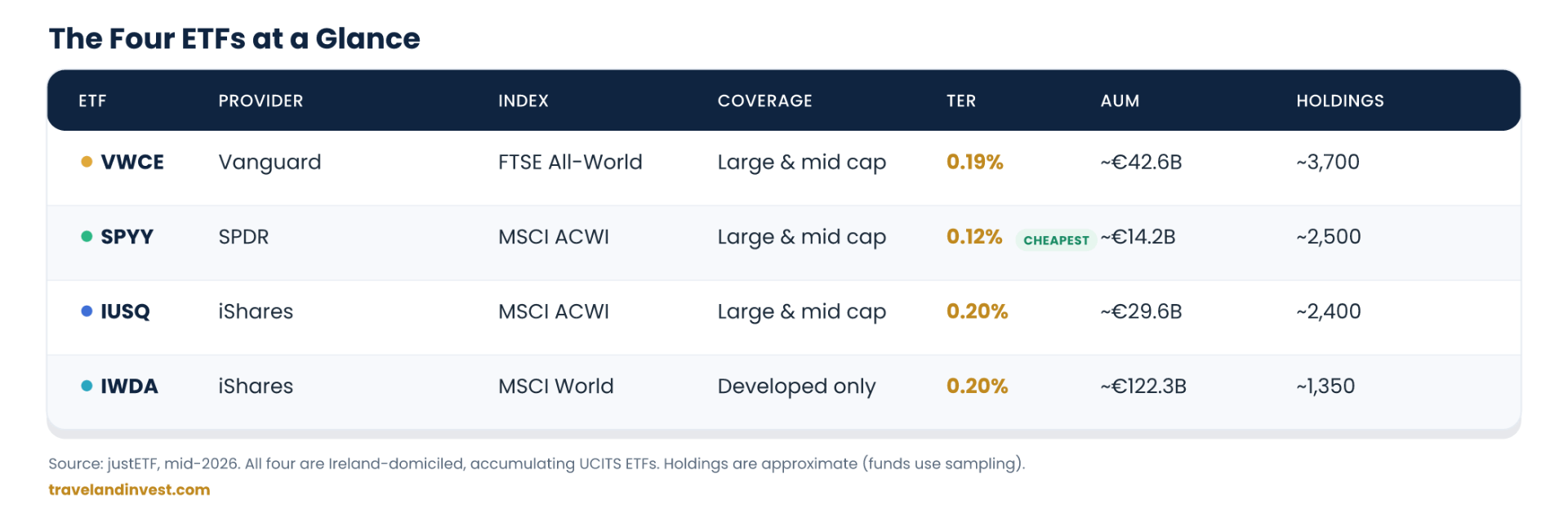
Before we go deep on each fund, here's the verified key data:
The Indexes Behind These ETFs: FTSE vs MSCI
Before picking a fund, it helps to understand what's powering it under the hood. Our four ETFs are built on just three indexes, run by two providers — FTSE Russell and MSCI. VWCE follows FTSE's All-World index; SPYY and IUSQ both track MSCI's ACWI; and IWDA tracks MSCI's World index. They all hold global stocks, but each does it in a slightly different way. So let's compare the three.

FTSE All-World
The FTSE All-World index is used by VWCE. It tracks roughly 4,200+ large- and mid-cap stocks across around 49 countries, covering both developed and emerging markets, approximately 90–95% of the global investable market. The US makes up around 60% of the index, followed by Japan, the UK and China.
One structural difference is how FTSE classifies countries. South Korea, for example, is classified as a developed market by FTSE but as an emerging market by MSCI. So VWCE counts Korean companies like Samsung as developed-market exposure, while MSCI-based funds count them as emerging markets. It's a small difference in practice, but worth knowing.
MSCI ACWI
The MSCI All Country World Index (ACWI) is used by both SPYY and IUSQ. It covers around 2,500 large- and mid-cap stocks across 23 developed and 24 emerging markets, representing about 85% of the global investable equity market. As of mid-2026, the US weight sits around 63.6%, followed by Japan (~5%) and Taiwan (~3.3%). Emerging markets make up roughly 12% of the index.
MSCI World (Developed Only)
IWDA tracks the MSCI World index, which covers developed markets only — no emerging markets at all. That means no China, no India, no Brazil, and (under MSCI's classification) no South Korea. It holds around 1,350 stocks across 23 developed countries, and the US dominates at roughly 70%.
The three indexes have performed remarkably similarly over the long term. We'll look at the actual numbers further down, in Index Performance.
VWCE: The Community Favourite
If you spend any time in European investing forums, VWCE comes up constantly. And for good reason.
VWCE is the Vanguard FTSE All-World UCITS ETF (Accumulating). It tracks the FTSE All-World Index across both developed and emerging markets, so a single purchase gives you exposure to the US, Europe, Japan and major emerging economies including China, India, Taiwan and Brazil.
The TER is 0.19% per year — that's €1.90 for every €1,000 invested annually. The fund has grown to over €42.6 billion in assets, making it highly liquid and available on virtually every European broker.
What makes VWCE compelling for beginners is its completeness. You buy it, set up a monthly contribution, and you're done. No need to manage multiple funds or rebalance between developed and emerging markets — the index handles all of that automatically.
Vanguard also operates differently from most fund providers: it's investor-owned rather than shareholder-driven, which structurally pushes fees down over time. That's a meaningful advantage for long-term investors, and small differences in fees compound into large differences over decades.
Best for: Investors who want a true all-in-one global solution. The most popular choice in the European retail investing community, for good reason.
SPYY: The Cheapest Way to Own the World
SPYY is the SPDR MSCI ACWI UCITS ETF from State Street. It tracks the same MSCI ACWI index as IUSQ that is large and mid-cap companies across developed and emerging markets. But it does so at the lowest cost of any fund in this comparison.
The TER is 0.12% per year, the cheapest physically-replicated all-world ETF available to European investors right now. The fund manages around €14.2 billion in assets — solid, though smaller than VWCE or IUSQ.
Here's the honest picture: because SPYY and IUSQ track the identical index, they'll deliver near-identical returns before costs. SPYY's edge is purely the lower fee (0.12% vs 0.20%) — over decades, that gap quietly adds up in your favour. The trade-off is that SPYY is less visible in retail forums, less frequently discussed, and has slightly lower trading volume, which can mean a marginally wider bid-ask spread. For long-term investors making monthly contributions, that's almost irrelevant — but it's worth knowing.
If you want small-cap exposure on top of large and mid caps, that's a different SPDR fund — SPYI, which tracks the MSCI ACWI IMI index (TER 0.17%). SPYY itself does not include small caps.
Best for: Cost-focused investors who want broad global coverage at the lowest annual fee among physically-replicated all-world ETFs, and who don't mind a less "famous" ticker.
IUSQ: The iShares All-World Flagship
IUSQ is the iShares MSCI ACWI UCITS ETF from BlackRock. It's the largest MSCI ACWI ETF in Europe, with around €29.6 billion in assets, and it's been running since 2011.
It tracks the MSCI ACWI index, covering roughly 2,400 holdings across both developed and emerging markets. As of mid-2026, the US makes up about 63.6% of the fund, followed by Japan and Taiwan. The top holdings are the usual mega-cap tech names — Nvidia, Apple, Microsoft, Amazon and Alphabet — which dominate most global indexes.
The TER is 0.20% per year, on par with IWDA, slightly more than VWCE, and notably more than SPYY (which tracks the same index for 0.12%). IUSQ does benefit from BlackRock's securities-lending programme, which can partially offset the cost in practice.
IUSQ is widely available across European and UK brokers and trades on multiple exchanges, including XETRA (ticker: IUSQ), Euronext Amsterdam (ticker: SSAC) and the London Stock Exchange (ticker: ISAC in USD, SSAC in GBP). That broad availability makes it easy to access regardless of your broker.
Best for: Investors who want a large, trusted, globally diversified fund from the world's biggest asset manager, with full developed and emerging market exposure — and who value size and track record over the last basis points of fee.
IWDA: The Developed-Market Powerhouse
IWDA is the iShares Core MSCI World UCITS ETF. It's been around since 2009, holds over €122.3 billion in assets, and is one of the most widely held ETFs in Europe among both retail and professional investors.
It tracks the MSCI World index, covering around 1,350 stocks across 23 developed markets only — no emerging markets, so no China, India, Taiwan or Brazil. The US dominates at roughly 70%, followed by Japan, the UK and France.
The TER is 0.20% per year. Like IUSQ, IWDA uses optimised physical sampling and earns securities-lending income that can partially offset the fund's costs.
Why pick IWDA over the all-world options? Some investors simply prefer to avoid the political and regulatory risks of holding Chinese or other emerging-market stocks. Others believe developed markets offer more transparent corporate governance. And the long-run data backs this up to a degree — MSCI World has slightly outperformed MSCI ACWI over the last two decades, largely because emerging markets have lagged.
If you do want emerging markets later, you can pair IWDA with a separate EM fund, for example EMIM (the iShares Core MSCI EM IMI UCITS ETF), to build a custom all-world portfolio at a blended cost you control.
Best for: Investors who want maximum exposure to developed-market global equities, one of the most liquid and proven funds in Europe, and the flexibility to add or skip emerging markets separately.
Accumulating vs Distributing: Which Should You Choose?
Every ETF in this article comes in at least two flavours: Accumulating (Acc) and Distributing (Dist). This is one of the most important decisions for European investors, yet most beginners overlook it completely.
What's the difference?
When a fund holds stocks, those companies pay dividends. The question is: what happens to that money?
Accumulating (Acc): Dividends are automatically reinvested back into the fund. Your share price grows to reflect this. You receive no cash payment.
Distributing (Dist): Dividends are paid out to you as cash, usually quarterly or annually. The money lands in your brokerage account to spend or reinvest manually.
Which one is better for long-term investors?
For most European investors in the wealth-building phase, accumulating is usually the better choice:
Compounding is automatic. Dividends are reinvested for you, with no action required.
It's simpler. No cash to manually reinvest, no odd amounts sitting idle.
It can be more tax-efficient in some countries.
That third point deserves care, because the tax treatment of Acc vs Dist depends entirely on your country of residence. In some countries accumulating funds defer tax and come out ahead; in others they don't help at all. Germany, for instance, applies an annual Vorabpauschale (advance lump-sum tax) to accumulating funds, and Ireland taxes ETF gains under a deemed-disposal rule regardless of whether you take the dividends. A few countries actually treat distributing funds more favourably. Check your local rules — or a local tax adviser — before assuming accumulating "wins."
The distributing version makes more sense if you're in the income phase — for example, if you're retired and want regular cash from your portfolio. If income investing appeals to you, it's worth reading up on dividend investing for European investors and keeping track of payouts with a tool like a portfolio dividend tracker.
All four ETFs in this article are accumulating by default. VWCE has a distributing sibling called VWRL, and IWDA has a distributing version on the LSE. Always double-check the "(Acc)" label when you buy.
Currencies: USD, EUR, or GBP?
Here's something that confuses a lot of beginners: the same ETF is often available in multiple currencies. VWCE trades in USD on some exchanges and EUR on others; SSAC trades in GBP on the London Stock Exchange. What does this actually mean for you?
The short answer: the trading currency doesn't really matter for long-term investors.
The underlying fund holds thousands of global stocks priced in their local currencies — dollars, yen, euros, pounds. The trading currency is just the denomination your broker uses to show the price and process the trade. It does not hedge the fund against currency movements.
For example, if you buy VWCE in EUR on XETRA, you're still fully exposed to the US dollar, because roughly 60% of the fund's holdings are US stocks priced in dollars. Buying in EUR rather than USD doesn't change that underlying exposure one bit.
Currency-hedged versions do exist, but they cost more and are generally not recommended for long-term passive equity investors. Hedging makes more sense for short-term trades or bond funds than for multi-decade equity holdings.
Which Exchange Should You Use?
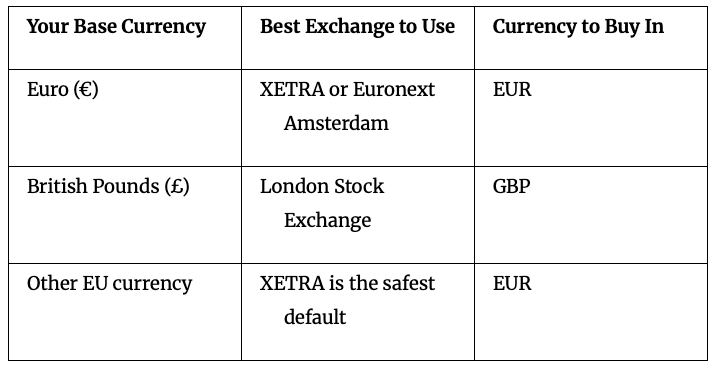
Each of these ETFs is listed on multiple European exchanges. The good news: the same fund trades on all of them, so you're always buying the same underlying asset. The only differences are where and in what currency.
XETRA (Germany)
The largest and most liquid ETF exchange in continental Europe, operated by Deutsche Börse. Most European brokers default to XETRA for ETF trades. VWCE, IUSQ, IWDA and SPYY all trade here in EUR.
Euronext Amsterdam (Netherlands)
Very popular with European investors and well-supplied with liquidity. VWCE, IUSQ and IWDA all trade here in EUR — particularly convenient for Dutch and Belgian investors whose brokers route to Amsterdam by default.
London Stock Exchange (UK)
Essential for UK investors, and the tickers are often different from the XETRA versions. VWRL and VWRP are the LSE versions of Vanguard's All-World fund; SSAC and ISAC are the LSE lines for iShares' ACWI fund. One quirk: on the LSE, some tickers are quoted in GBX (pence), not GBP (pounds) — so a price of "10,450" means £104.50, not £10,450. Don't let it startle you.
Borsa Italiana (Italy)
Useful for Italian investors. Lower volumes than XETRA, but perfectly functional for regular monthly investing.
General rule
Use whichever exchange your broker defaults to. For most European brokers that's XETRA; for UK brokers it's the LSE.
Don't overthink it — the underlying fund is identical regardless of the exchange.
Index Performance: What Returns Can You Realistically Expect?
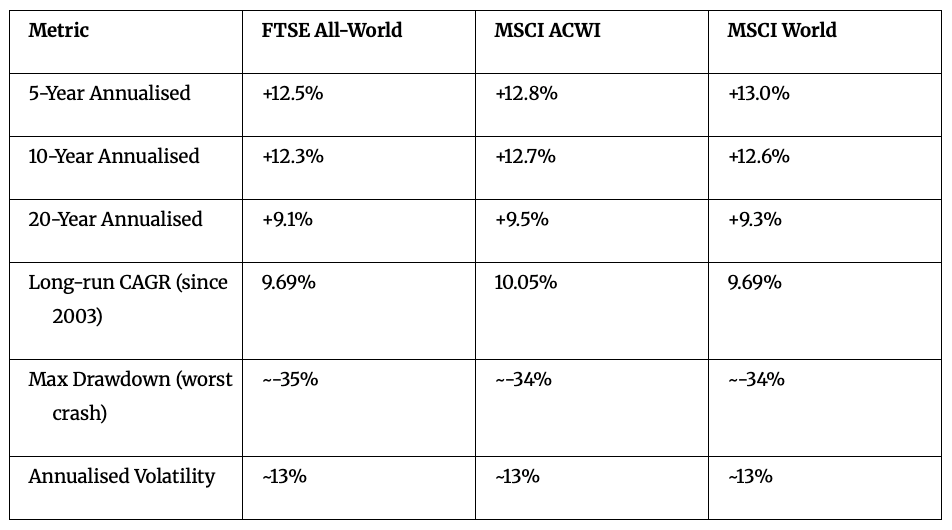
Let's talk numbers. Here's how the three underlying indexes have performed, based on historical backtests:
Note: Past performance does not guarantee future results.
The key takeaway? All three indexes perform remarkably similarly over the long term. MSCI World has edged slightly ahead because it excludes emerging markets, which have been a drag over the past 15 years — but over multi-decade horizons the differences are tiny.
What does this mean in real money? If you invest €500 per month, assuming an average 9% annual return, here's roughly how the pot grows — a great illustration of why investing consistently every month matters more than timing:
After 10 years: ~€95,000
After 20 years: ~€330,000
After 30 years: ~€900,000+
That's compounding doing its job quietly in the background. The earlier you start, the bigger the snowball gets.
One important caveat: those 10-year annualised returns of 12%+ reflect a particularly strong decade for global equities, driven heavily by US tech. A more conservative long-term planning assumption is 7–9% per year, which aligns better with the 20-year average.
Which One Should You Actually Buy?
Here's the simple version:
Just starting out and want simplicity → buy VWCE.
You want the lowest possible fee for all-world exposure → SPYY (same index as IUSQ, cheaper).
You want a large, established fund from a big-name provider → IUSQ.
You're happy without emerging markets and want the most liquid fund in Europe → IWDA.
You want to control your EM exposure separately → start with IWDA, then add EMIM later.
The biggest mistake new investors make is waiting. All four of these funds are excellent choices, and the difference between them is small compared to the difference between investing today and waiting another year. (If you're still torn between going global and going US-only, our S&P 500 vs All-World breakdown walks through that decision.)
Where to Buy These ETFs in Europe
All four ETFs are available on the main European and UK brokers, including:
Trading 212
DEGIRO
Scalable Capital
Freetrade
New to this? Here's how to start investing with as little as €100.
If you're in the UK, make sure you buy the UCITS versions of these ETFs, not US-listed products. UK and EU retail investors generally cannot legally purchase US-domiciled ETFs like Vanguard's US-listed VT, because those funds don't provide the required European disclosure document (KID).
Frequently Asked Questions
What is the best all-world ETF for European investors? There's no single "best" — it depends on your priorities. VWCE is the most popular all-in-one choice, SPYY is the cheapest at 0.12%, IUSQ is the largest iShares ACWI fund, and IWDA is the most liquid (though developed-markets only). All four are strong, low-cost UCITS funds.
What's the difference between FTSE All-World and MSCI ACWI? Both track global large- and mid-cap stocks across developed and emerging markets. FTSE All-World holds more constituents (~4,200 vs ~2,500) and classifies South Korea as developed; MSCI ACWI classifies it as emerging. Long-term returns are nearly identical.
Is VWCE or IWDA better? VWCE is a true all-world fund (developed + emerging markets). IWDA holds developed markets only, so it excludes China, India and other emerging economies. Choose VWCE for one-fund global exposure, or IWDA if you prefer developed markets or want to add emerging markets separately.
Should I choose accumulating or distributing? For wealth-building, accumulating is usually simpler and lets dividends compound automatically. Distributing suits investors who want regular cash income. Which is more tax-efficient depends entirely on your country of residence, so check your local rules.
Does the trading currency (EUR, USD, GBP) affect my returns? No. The trading currency is just the denomination your broker shows. Your real currency exposure comes from the fund's underlying holdings — around 60% of which are US stocks priced in dollars, regardless of the currency you buy in.
The Bottom Line
Investing doesn't have to be complicated. Four world-class funds. Thousands of companies. One monthly contribution. That's really all it takes to build long-term wealth.
Whether you go with VWCE's simplicity, SPYY's low cost, IUSQ's BlackRock backing, or IWDA's massive liquidity, you're making a smart financial decision. The best time to invest was ten years ago. The second best time is today.
Nobody here is a licensed or certified financial adviser, and nothing in this article is investment advice. It is informational and educational only. Investments can fall as well as rise — do your own research, and speak to a qualified professional who knows your circumstances before acting on anything you read here.