What Is a UCITS ETF? A Clear Explanation
Published
UCITS explains why some ETFs are blocked in Europe and others aren't. Here's what the label actually requires.

The regulation that quietly decides which ETFs you're even allowed to buy.
Quick take: UCITS is an EU regulatory framework that most ETFs sold to European retail investors must follow. It sets rules on diversification, liquidity and disclosure, and it's the reason your broker lets you buy funds like VWCE but blocks certain popular US-listed ETFs. UCITS funds are almost always domiciled in Ireland or Luxembourg, and that choice quietly affects how much tax gets taken out of your dividends. UCITS is not a guarantee against losses. It's a structural standard, not insurance.
If you've read any ETF article on this site, or spent time in a European investing forum, you've seen the word UCITS attached to nearly every fund. It shows up in ticker names, broker filters and fact sheets, usually with no explanation. Most guides assume you already know what it means. This one doesn't.
What UCITS Actually Stands For
UCITS stands for Undertakings for Collective Investment in Transferable Securities. It's a mouthful, and you don't need to remember it. What matters is that it's an EU rulebook for investment funds, not a company or a brand.
The rules date back to 1985 and were updated into their current form under an EU directive (Directive 2009/65/EC, if you ever need the reference). They're overseen at the EU level by a body called ESMA, and enforced day to day by each country's own regulator, the Central Bank of Ireland for Irish-based funds, for example.
The UK kept an equivalent set of rules after Brexit rather than scrapping them, so UCITS still means roughly the same thing whether you're investing from Germany, Spain or the UK. More on the UK specifically further down.
What Being UCITS Compliant Actually Requires
A fund doesn't get to call itself UCITS just by asking. It has to meet a set of real requirements, including:
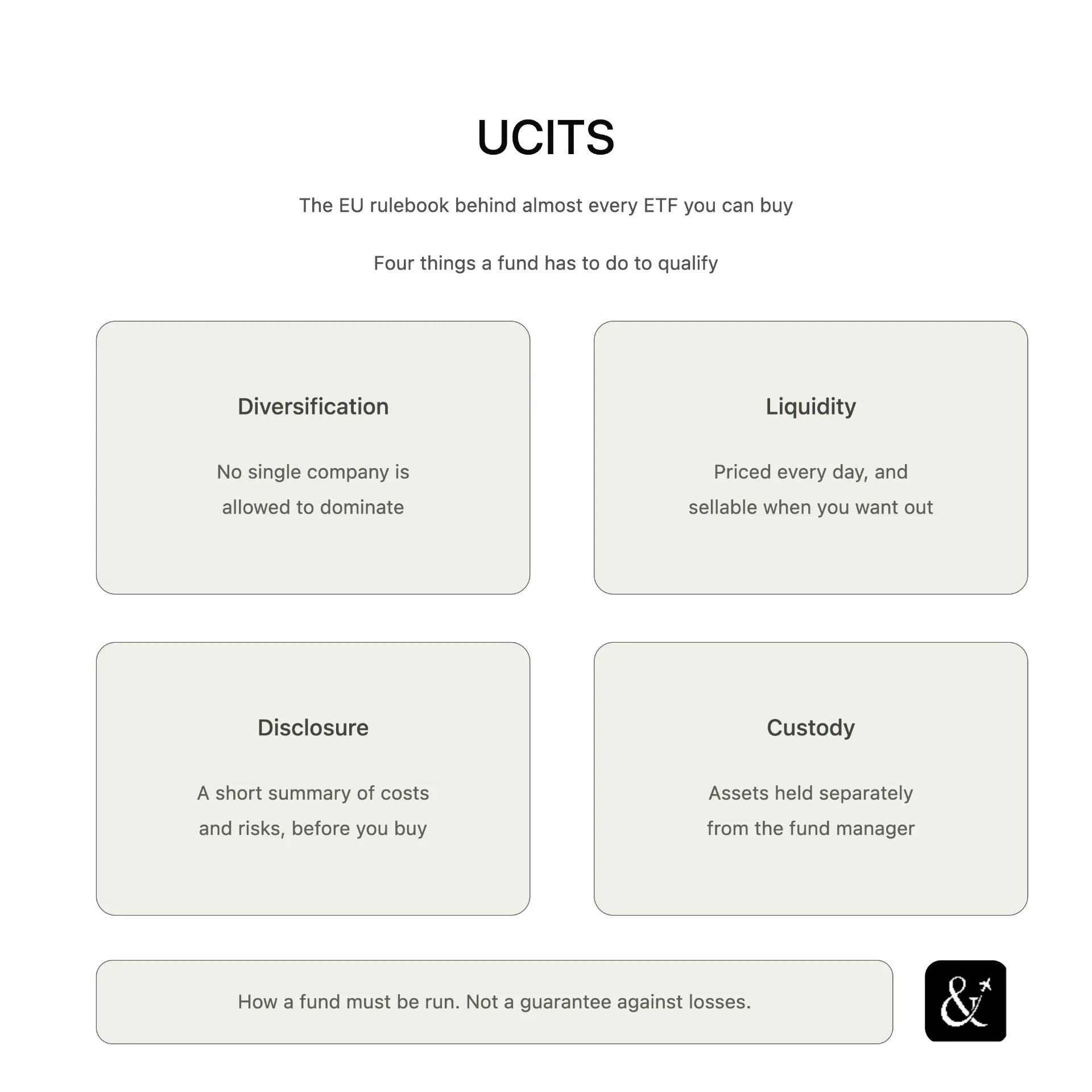
Diversification. A UCITS fund isn't allowed to put too much of your money into a single company. There's a formal limit on this (you'll sometimes see it called the "5/10/40 rule"), but the plain-language version is simple: no single company can dominate the fund, and a small handful of large positions can't be allowed to take it over either. Funds tracking a more concentrated index, like one built around a small number of giant tech companies, get a bit more flexibility here, but the same basic principle still applies.
Liquidity. UCITS funds have to publish their value every day and hold assets that can realistically be sold when investors want their money back.
Disclosure. Every UCITS fund has to publish a short, standardised document (a Key Information Document, or KID) covering costs, risks and past performance, in your own language, before you buy.
Custody. The fund's actual assets are held by an independent custodian, separate from the company managing the fund, so the fund manager can't simply run off with the money.
None of this makes a UCITS fund risk-free. It's a floor of investor protection and disclosure, not insurance against the fund losing value. If global markets fall, your UCITS ETF falls with them, exactly like any other equity fund.
Why This Is the Reason You Can't Just Buy Certain US-Listed ETFs
Here's where UCITS stops being trivia and starts explaining something you've probably run into directly. Try to buy a popular US-listed ETF like Vanguard's VOO or Invesco's QQQ on a European broker, and the order gets rejected.
The reason is a separate EU rule called PRIIPs, in force since 2018 and applied fully to UCITS funds since 2023. In plain terms: before a fund can be sold to a retail investor in the EU, it has to publish that KID document mentioned above. US ETF providers generally don't produce one, partly because US rules don't allow the kind of future-performance predictions a KID requires. No KID means a European broker legally can't sell you the fund, so it blocks the order rather than risk breaking the rule.
This isn't a ban on the fund itself, and it isn't illegal to hold shares you already bought before the rule applied. It's simply a paperwork mismatch between two regulatory systems, enforced at the point of sale.
Some investors get themselves reclassified as "professional" clients, which removes this restriction, but it usually requires a large portfolio or a lot of trading history to qualify, and it means giving up standard retail protections along the way. It's not a shortcut worth taking lightly.
This gap is exactly why UCITS versions of popular US funds exist. VWCE, IUSQ, SPYY and IWDA aren't cheap knockoffs of their US counterparts. They're the EU-compliant version, built specifically so European investors can get similar global exposure without hitting the KID problem. If you want to see how four of the most popular ones compare, our breakdown of VWCE, SPYY, IUSQ and IWDA walks through fees, holdings and how to buy each one.
What This Means If You're Investing From the UK
Short version: UCITS is still relevant to you, and the block on certain US-listed ETFs works in much the same way.
After Brexit, the UK didn't scrap PRIIPs and UCITS, it built its own versions. The details differ slightly from the EU's, but the underlying job is the same. In practice:
Popular Ireland-domiciled UCITS ETFs, VWCE, IWDA and IUSQ among them, are recognised for sale to UK investors, and your broker handles the paperwork behind the scenes. You don't need to check this yourself.
The UK is currently in the middle of swapping its own disclosure document for a new one, called a "Product Summary", replacing the old PRIIPs-style KID. The changeover started in April 2026 and finishes by mid-2027. It's a change in format, not in substance: a fund still has to produce one of these documents before a UK broker can sell it to you. So popular US-listed ETFs are expected to stay off-limits on UK brokers for essentially the same reason as before.
Everything else in this article, the diversification rules, the domicile check, Ireland vs Luxembourg, applies to a UK investor exactly the same way it applies to someone investing from France or the Netherlands.
Why the Same Fund Trades on Several Exchanges
One underrated part of UCITS status: once a fund is approved, it can generally be sold right across the EU (and, once recognised, the UK) without needing separate approval in every single country. That's why the same fund often shows up on several exchanges at once, XETRA in Germany, Euronext Amsterdam, Borsa Italiana in Italy, the London Stock Exchange, each with its own ticker and currency.
Buying VWCE on XETRA in euros and buying its LSE-listed sibling in pounds gets you the same underlying fund. Only the trading venue and the currency you see on screen are different, the fund itself, its holdings and its fees are identical. If you're deciding which exchange to actually use, our All-World ETF comparison covers that in more practical detail.
Where These Funds Actually Live: Ireland vs Luxembourg
UCITS funds need a home country, called a domicile, and in practice almost all of them sit in one of two places: Ireland or Luxembourg. Ireland is by far the more common choice, largely because of a tax treaty with the US that caps US withholding tax on dividends paid to Irish-based funds at 15%, versus 30% for most Luxembourg-based equivalents. That difference happens inside the fund, before a cent reaches your brokerage account.
You can check a fund's domicile in seconds. Every ETF has an ISIN, a code made up of letters and numbers, and the first two letters tell you the country: IE for Ireland, LU for Luxembourg. VWCE, for example, carries the ISIN IE00BK5BQT80, confirming it's Irish.
Domicile affects more than just dividend tax, and the fuller picture, including how it interacts with US estate tax exposure if you hold US shares directly, is covered in our piece on the hidden costs of owning US stocks. Worth reading if you hold, or are thinking about holding, US shares or funds directly rather than through a UCITS wrapper.
How to Check If a Fund Is UCITS Compliant
Three simple checks, any one of which is usually enough on its own:
The fund name includes "UCITS". Most providers put it directly in the name.
The ISIN starts with IE or LU (the two most common domiciles).
Your broker or the provider's website has a KID available to download.
If a fund fails all three, it very likely isn't accessible to you as a retail investor in Europe in the first place, and your broker will usually block the order before you get far enough to check manually.
Where You Can Actually Buy These
Every major European broker offers UCITS ETFs, since it's effectively the only type of ETF they're allowed to sell you as a retail investor in the first place. Interactive Brokers and Lightyear, both reviewed in detail elsewhere on this site, are two solid options. Trading 212 is another popular and beginner-friendly choice. Whichever broker you use, the UCITS status of a fund doesn't change, what matters is the fund itself, not the platform you buy it through.
What UCITS Status Doesn't Mean
Worth repeating plainly: UCITS is a regulatory and disclosure standard, not a performance guarantee or a stamp of safety from loss. A UCITS-compliant global equity ETF can still fall 30% or more in a bad year, exactly like its US-listed equivalent would. What UCITS buys you is diversification limits, transparency and custody protections, not protection from ordinary market risk. Anyone telling you a fund is "safe because it's UCITS" is misunderstanding what the label actually covers.
Frequently Asked Questions
What does UCITS stand for? Undertakings for Collective Investment in Transferable Securities. It's an EU regulatory framework for retail investment funds, not a company or brand.
Why can't I buy some US-listed ETFs from Europe? Because of a separate rule called PRIIPs, which requires a short disclosure document before a retail investor can buy a fund. Most US ETF providers don't produce one for the EU market, so European brokers generally can't sell those funds to retail clients.
Is a UCITS ETF safer than a US-domiciled one? Not in terms of market risk. UCITS status guarantees diversification limits, disclosure and custody standards, not protection against the fund losing value.
Does the domicile of a UCITS fund matter? Yes, for funds with meaningful US exposure. Ireland-domiciled funds generally face 15% US withholding tax on dividends under a US-Ireland tax treaty, compared with 30% for most Luxembourg-domiciled equivalents. Check the ISIN prefix, IE or LU, to identify domicile quickly.
Does UCITS still apply if I'm investing from the UK? Yes. The UK kept its own version of the UCITS and disclosure rules after Brexit, so the same broad principles apply, including why certain US-listed ETFs remain unavailable on UK brokers.
Does UCITS status mean I can't lose money? No. UCITS is a structural and disclosure standard. A UCITS ETF tracking global equities will still rise and fall with the market, and losses are entirely possible.
Nobody here is a licensed or certified financial adviser, and nothing in this article is investment advice. It is informational and educational only. Investments can fall as well as rise — do your own research, and speak to a qualified professional who knows your circumstances before acting on anything you read here.
Some of the links in this article are affiliate links. Using one costs you nothing extra, and we earn a small commission that helps keep this site running. If anything here saved you time or money, booking through our links is the easiest way to say thanks.