Battle of Titans: S&P 500 vs All-World ETFs. A Long-Term Investor's Guide
Published · Updated
Ten years of S&P 500 outperformance, and a decade before that which cost a euro investor 36%. What the comparison actually turns on, and it is not the fee.

Over the past ten years the S&P 500 has beaten a global all-world index comfortably, and that gap is the reason most people ask this question in the first place. It is also only part of the picture. The same index handed a euro investor a loss of roughly a third across 2000 to 2009, and the global index has been ahead in both 2025 and 2026 so far. An S&P 500 UCITS ETF costs slightly less and holds one country. An all-world UCITS ETF holds those same American companies plus everything else. What you are really deciding is how concentrated you want to be.
The short answer
Three things settle this, and the ten-year return chart is not one of them.
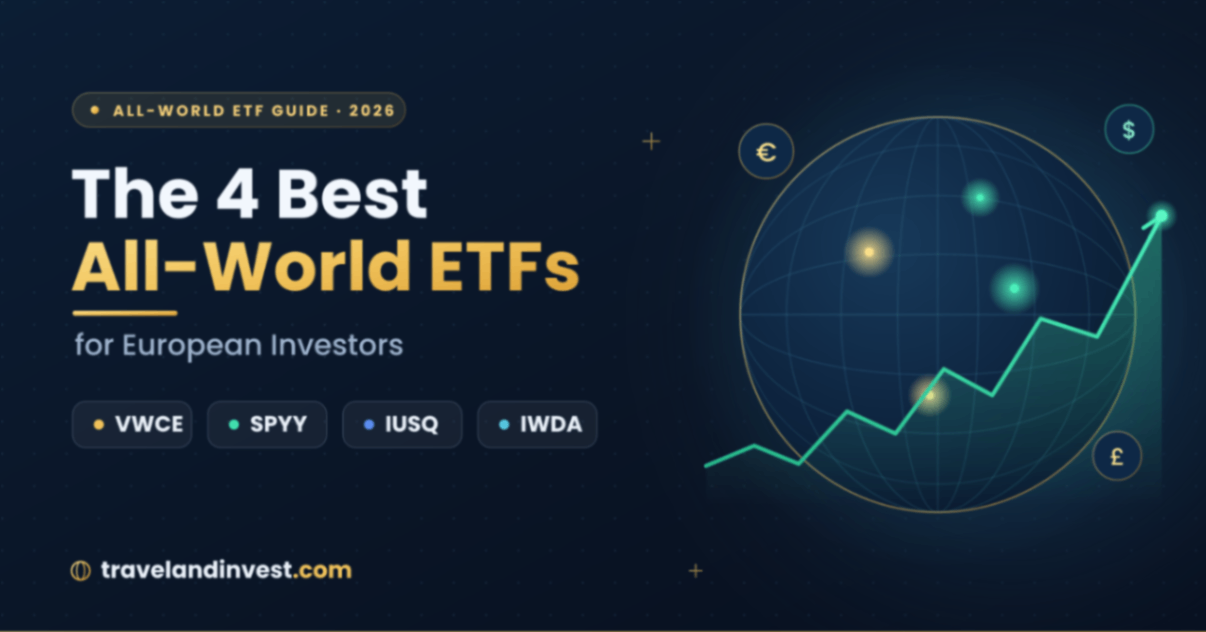
They are not really alternatives. The Vanguard FTSE All-World UCITS ETF held the United States at 59.77% as at 31 August 2026, and nine of its ten biggest positions are American companies. So choosing all-world does not mean avoiding the American market. It means holding it at around 60% rather than all of it.
The cost gap is small. The iShares Core S&P 500 UCITS ETF charges 0.07% a year and the Vanguard fund charges 0.14%. On a 10,000 euro holding the difference works out at roughly 7 euros a year, which is worth knowing but not worth building a portfolio around.
Currency does more damage than people expect. Across 2000 to 2009 a euro investor in the S&P 500 lost about 36%, not the 9% figure quoted in dollars. The full calculation is further down, and it is the main reason this article exists.
What is actually inside each one
The S&P 500 holds 500 large companies listed in the United States. All of them are American. There are no Japanese, German, Taiwanese or Indian companies in it anywhere.
The FTSE All-World index casts a much wider net, covering large and mid-cap companies across developed and emerging markets, roughly 90 to 95% of the global investable market. The Vanguard fund tracking it held 3,759 positions as at 31 August 2026, split across the United States at 59.77%, Japan at 5.97%, Taiwan at 3.29% and the United Kingdom at 3.25%, with the remainder spread thinly across everywhere else.
Here is the bit that tends to surprise people. The all-world fund's biggest holdings are the same companies as the S&P 500's biggest holdings. NVIDIA, Apple, Microsoft, Amazon and Alphabet sit near the top of both lists. If the UCITS wrapper itself is unfamiliar, what a UCITS ETF is and why the structure matters in Europe covers that separately.

Side by side
Fund data verified on justETF on 30 September 2026.
iShares Core S&P 500 | Vanguard FTSE All-World | |
|---|---|---|
Ticker on Xetra | SXR8 | VWCE |
ISIN | IE00B5BMR087 | IE00BK5BQT80 |
Ongoing charge | 0.07% | 0.14% |
Fund size | EUR 136,234m | EUR 52,912m |
Holdings | 503 | 3,759 |
Domicile | Ireland | Ireland |
United States weight | 100% | 59.77% |
Index returns in Euro, from justETF on the same date.
Period | S&P 500 | MSCI ACWI |
|---|---|---|
2026 year to date | +16.48% | +17.45% |
1 year | +19.81% | +21.61% |
5 years | +92.56% | +77.92% |
2025 | +3.96% | +8.22% |
2024 | +32.62% | +24.82% |
Return per risk, 5 years | 0.80 | 0.88 |
Start at the bottom of that second table rather than the top. Over five years the S&P 500 is well ahead, which is the number everyone cites. But the global index came out in front in 2025 and again so far in 2026, and once you adjust for how much volatility you had to sit through, it scores better over five years despite the lower headline return.
The lost decade, recalculated in euro
Every article about the S&P 500's worst stretch quotes the same number: around minus 0.95% a year from the start of 2000 to the end of 2009. The figure is accurate. It is also in US dollars, which means no European investor actually experienced it.
The euro climbed hard against the dollar over those ten years. The European Central Bank's reference rate was 1.0046 dollars per euro at the end of 1999 and 1.4406 by 31 December 2009. So the dollar shed 30.3% of its euro value, and that came on top of a market that went nowhere for a decade.
Method. Annual S&P 500 total returns with dividends reinvested, compounded across 2000 to 2009, then converted using the ECB reference rate at each end of the period.
US dollars | Euro | |
|---|---|---|
Cumulative, 2000 to 2009 | -9.12% | -36.62% |
Annualised | -0.95% | -4.46% |
10,000 becomes | 9,088 | 6,338 |
Put 10,000 euros into the S&P 500 on the first trading day of 2000, hold it for ten full years without flinching, and you finished with about 6,338 euros. That is not a flat decade. That is losing more than a third of your money while doing everything right. Emerging markets, over the same ten years, compounded at close to 10% a year in dollar terms.
A few caveats worth stating. This is an index calculation rather than a fund one, and neither fund in the table above existed for most of that decade, so a real investor would also have paid an ongoing charge and, depending on where they lived, tax. It says nothing about what the next ten years will look like. What it does show is that a decade is not long enough to count on a positive result from a single country, and that for anyone holding in euros the currency is part of the risk rather than a detail at the end of the page.
The currency point that gets stated backwards
An S&P 500 UCITS ETF gives a euro investor more dollar exposure than an all-world fund does, not less. Every single holding is American. The all-world fund spreads that exposure across dozens of currencies, with the dollar sitting at around 60%.
Buying the euro-quoted line does not change any of this, which trips up a lot of people. The Vanguard FTSE All-World UCITS ETF trades as VWCE in euro on Xetra, as VWRA in dollars on the London Stock Exchange and as VWRP in pounds on the same exchange. Same fund, same holdings, three tickers. What changes is the currency your broker shows you and the currency that leaves your account, not what you own.
So if dollar exposure is what worries you, concentrating further into American companies is not the way to deal with it.
How to choose
Do you already own an S&P 500 fund? Buying an all-world fund alongside it does not cancel out the concentration, because the all-world fund holds those same companies. Work out your combined American weight before adding anything.
Do you have an actual view on American outperformance continuing? If you do, an S&P 500 fund expresses it cleanly. If you do not, the all-world fund is the one that does not require you to have an opinion. Neither position is cleverer than the other, but holding a view you have not really formed is how people end up switching at the worst moment.
How would you have handled a decade like 2000 to 2009? If you suspect you would have stopped contributing partway through, that matters a great deal more than seven basis points. How investment psychology affects real outcomes goes into why.
Will you keep buying either way? A simpler portfolio you actually contribute to every month beats a cleverer one you abandon in year three. Over a long horizon, investing a fixed amount every month does far more work than picking between these two indexes.
Two things to settle separately, because they apply whichever you pick: fund domicile, which happens to be Ireland for both funds here and is explained in the hidden costs of owning US stocks, and the accumulating or distributing question, covered in accumulating and distributing UCITS ETFs by country.
What I hold, and what I got wrong
My first UCITS holding was the iShares Core S&P 500 UCITS ETF, ticker SXR8. I bought it because it was the fund everyone kept recommending and the returns looked impossible to argue with.
I later moved my regular buying to an all-world fund, for three reasons, none of which was a bet on performance. I am not convinced American dominance is permanent, which is less a prediction of decline than an admission that I do not know. China and India have room to grow in a way developed markets do not, and a global index picks that up on its own if it happens. And I wanted some European companies in there, which an S&P 500 fund gives you none of. The United States is still the dominant chunk of my portfolio, deliberately, at roughly 60%.

The core these days is the Vanguard FTSE All-World UCITS ETF (IE00BK5BQT80, VWCE on Xetra) at Interactive Brokers, alongside the State Street SPDR MSCI All Country World UCITS ETF (IE00B44Z5B48, SPYY) at Trading 212. Two brokers rather than one is deliberate, for platform diversification. How I split a core from satellites covers how the rest fits around it.
Two things I would do differently.
I still hold the SXR8 shares. I moved my buying across but never dealt with the existing position, and I keep meaning to sell it. In most European countries there is a solid reason to leave a legacy holding alone, because selling crystallises a taxable gain. Cyprus, where I am tax resident, charges no capital gains tax on securities, so I cannot even claim that excuse. It is simply a decision I have not got round to making.
I also created an overlap without doing the arithmetic. Holding both funds means my real American weight sits above 59.77%, because the SXR8 position stacks on top of the American holdings already inside the all-world fund. I never ran that number when I started buying the second fund. Anyone adding a fund to an existing portfolio should.
Frequently asked questions
Is the S&P 500 or an all-world ETF better for a European investor? Neither is better in the abstract. The S&P 500 has returned more over five and ten years while holding a single country, and an all-world fund holds those same American companies at roughly 60% weight alongside everything else, for about seven extra basis points a year.
Does an all-world ETF already include the S&P 500? Yes. The Vanguard FTSE All-World UCITS ETF held the United States at 59.77% as at 31 August 2026, and nine of its ten largest positions were American companies.
Did the S&P 500 really lose money over a decade? It did. From the start of 2000 to the end of 2009 it returned about minus 0.95% a year in US dollars with dividends reinvested. A euro investor came out at roughly minus 4.46% a year, because the dollar lost 30.3% of its euro value over the same stretch.
Do I avoid currency risk by buying the S&P 500 instead of all-world? No, it works the other way round. An S&P 500 UCITS ETF gives a euro investor more dollar exposure, since every holding is American.
Does buying VWCE in euro on Xetra remove currency risk? No. The trading currency affects what your broker displays and what leaves your account, not what the fund holds. VWCE, VWRA and VWRP are the same fund quoted in three currencies.
Should I hold both? You can, but work out the combined American weight first. An all-world fund already contains the S&P 500 companies, so adding a dedicated S&P 500 fund on top increases concentration rather than spreading it.

How this article was verified
Every fund figure was checked on justETF on 30 September 2026 rather than taken from a secondary summary. Fund data moves constantly, so treat each figure as accurate on that date and check before acting on it.
The euro calculation covering 2000 to 2009 is original to this article, and the method, inputs and limitations are set out in that section.
Sources
iShares Core S&P 500 UCITS ETF (Acc), IE00B5BMR087: ongoing charge 0.07%, fund size EUR 136,234m, 503 holdings, Ireland domiciled. justETF, read 30 September 2026.
Vanguard FTSE All-World UCITS ETF (USD) Accumulating, IE00BK5BQT80: ongoing charge 0.14%, fund size EUR 52,912m, 3,759 holdings, Ireland domiciled. Country and holdings weights as at 31 August 2026. justETF, read 30 September 2026. https://www.justetf.com/en/etf-profile.html?isin=IE00BK5BQT80
S&P 500 and MSCI ACWI index returns in euro. justETF index comparison, read 30 September 2026. https://www.justetf.com/en/asset-comparisons/index-comparisons/sp-500-vs-msci-acwi
S&P 500 annual total returns with dividends reinvested, 2000 to 2009. Slickcharts. https://www.slickcharts.com/sp500/returns
ECB euro reference rate for the US dollar, year-end 1999, 1.0046. Deutsche Bundesbank, Exchange Rate Statistics.
ECB euro reference rate for the US dollar, 31 December 2009, 1.4406. European Central Bank, series EXR.D.USD.EUR.SP00.A. https://data.ecb.europa.eu/data/datasets/EXR/EXR.D.USD.EUR.SP00.A
Nobody here is a licensed or certified financial adviser, and nothing in this article is investment advice. It is informational and educational only. Investments can fall as well as rise — do your own research, and speak to a qualified professional who knows your circumstances before acting on anything you read here.